
Kizen’s AI Agents: Build, Train & Scale In Under 30 Days. Learn more.
Kizen’s AI Agents: Build, Train & Scale In Under 30 Days. Learn more.
July 16, 2026
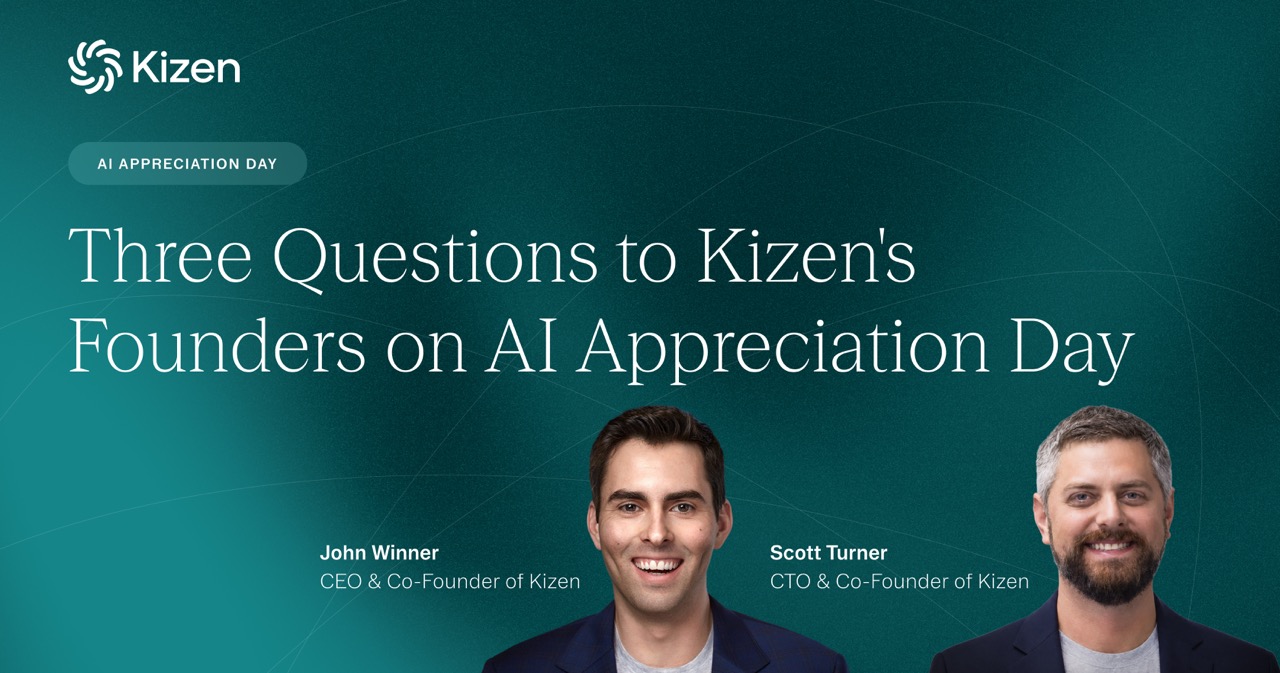
For AI Appreciation Day 2026, we sat down with Scott Turner, Kizen’s CTO and co-founder, and John Winner, CEO and co-founder, to have a candid conversation about Kizen’s origin story, vision, progress in the world of AI, and where we’re headed next.
Author
Kizen
Scott: We’ve been vocal about AI since day one of Kizen’s story, long before this current AI cycle. A decade ago, we realized that building for AI required a fundamental shift in architecture. We treated every unit of work as an abstract, modular component. At that time, the importance of data consistency wasn't broadly known like it is now, so we built ahead for a world where agentic orchestration would eventually be possible. That architectural foresight of building a flexible self-learning system that evolves with the user from the first line of code written is why we’re positioned the way we are today.
John: I remember a pivotal moment in the mid-2010s while discussing automation and AI with a colleague over lunch. We realized the profound potential to help individuals and businesses learn and improve exponentially with the emerging technology that was AI. This sparked the concept of continuous improvement, which became the cornerstone of our self-learning architecture. It also inspired the name 'Kizen', representing our commitment to continuous improvement and using AI to power what’s possible.
John: Beyond the workplace, AI is making remarkable strides in unexpected areas. Take modern golf clubs as an example. Nowadays they use AI-driven designs that optimize performance, helping golfers hit straighter, further, and more accurate shots.
More related to our work at Kizen, I’d highlight the impact of AI in healthcare and pharma, where I’m convinced AI will help deliver transformative breakthroughs that will provide immense, long-term benefits to society.
Scott: The internet gave us access to a wealth of human knowledge, but it didn’t solve the problem of tailoring data or information to the individual. The natural language interaction that a lot of people can access today is really helping the human experience. For example, my in-laws recently planned a vacation to Australia with the help of AI in minutes. They got a helpful assistant that gave them time back instead of spending hours searching the internet for sources that weren’t tailored to their needs.
That said, I always emphasize that AI can be a phenomenal assistant, but it's not a blind doer. As a user, leverage it to help you streamline monotonous tasks, but never forget to verify the results.
John: I’m incredibly excited about the evolution of conversational agents. We are truly only witnessing the beginning of what’s possible. Within the next year, I expect these agents to become more powerful and more helpful, offering unparalleled assistance across a vast spectrum of both personal and worklife scenarios.
Scott: Kizen. I’m less focused on the arms race to “the best model”. I think we’re already getting very close to practical performance ceilings there. What I’m more excited about is system integration - how we will work AI into resilient workflows in a model-agnostic fashion to amplify business value.
%20Large.jpeg)