Kizen’s AI Agents: Build, Train & Scale In Under 30 Days. Learn more.
Kizen’s AI Agents: Build, Train & Scale In Under 30 Days. Learn more.
December 19, 2025
Why most enterprise AI breaks in production and how an orchestration layer turns powerful models into reliable, governed workflows.
Author
Kizen
If you’re leading AI initiatives today, the challenge isn’t access to models or tooling. You already have that. The challenge is what happens when those models touch real workflows, real data, and real constraints.
Systems that look great in isolation start behaving unpredictably once they’re stitched into production processes. Accuracy slips across multi-step processes, unexpected outputs surface downstream, and security and governance concerns slow progress.
In reality, what’s missing is an orchestration layer. The infrastructure required to manage how AI operates across complex, production-grade workflows.
LLMs are more capable, tooling is improving, and AI is now a priority for most technology leaders.
But as organizations move beyond experimentation and into production, systems that perform well in isolation begin to break down inside complex workflows. Accuracy slips across multi-step processes, unexpected outputs surface downstream, and security and governance concerns slow progress.
What often looks like a model limitation is actually an infrastructure gap. The issue is the absence of an AI orchestration layer to manage how those models operate at scale.
LLMs are excellent at completing a single, well-defined task. Enterprise workflows, however, involve structured sequences: validating data, applying business rules, querying internal systems, generating content, triggering actions, and verifying outcomes.
As Antoine Gargot, Director of Data at Kizen, explains it, the more responsibility you give a single model, the less reliable it becomes. Accuracy drops when too many tasks are bundled together, which is why teams naturally start breaking workflows into smaller steps, such as micro-decisions, validations, and independently handled actions.
But once work is split into pieces, something still has to coordinate how those pieces run: which agent goes first, what data each step can access, how failures are handled, and whether the final outcome actually matches the original intent.
That coordination layer is orchestration.
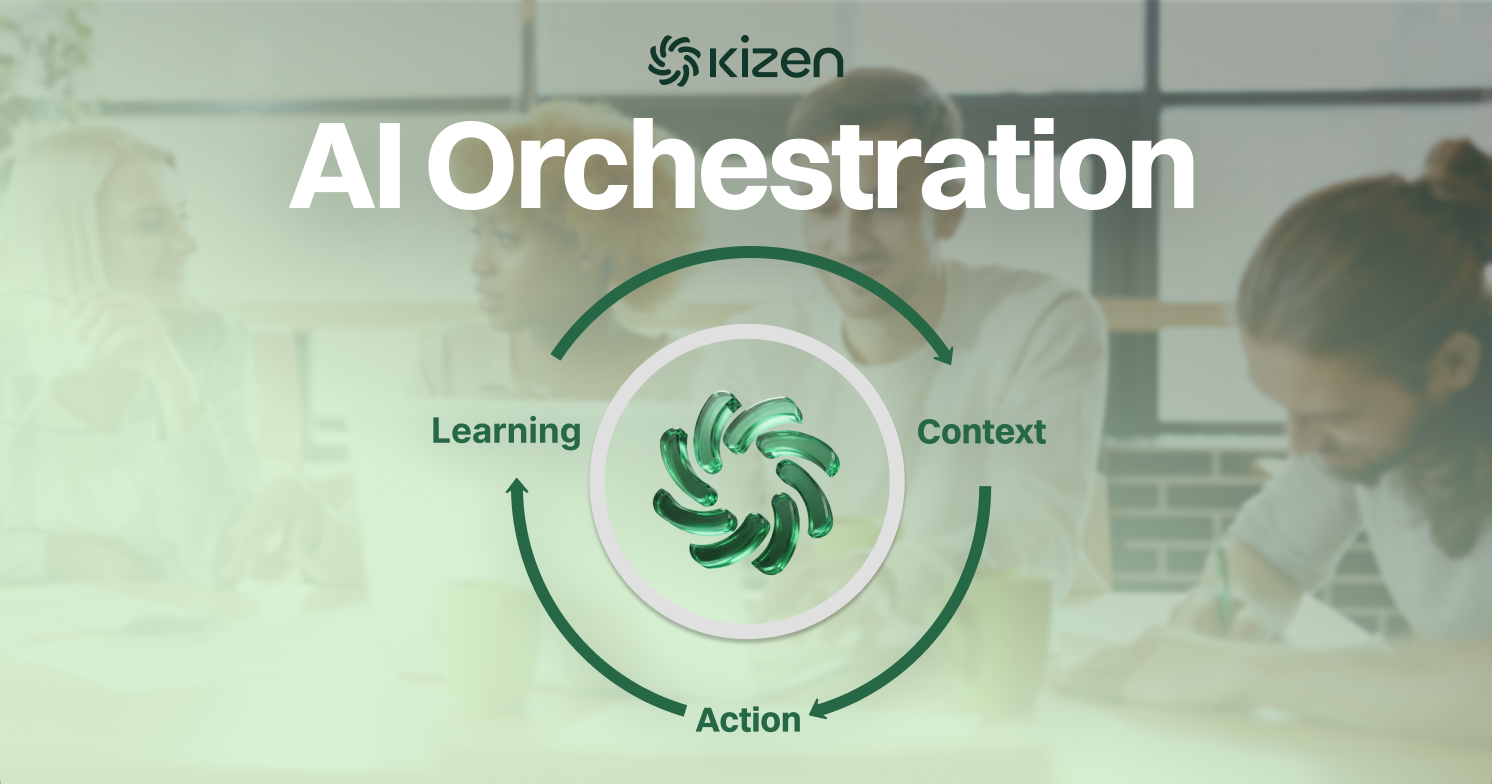
An AI orchestration layer governs how AI operates across an entire workflow, rather than relying on a single model to handle everything end to end.
Instead of bundling multiple steps into one request, orchestration breaks work into discrete tasks and coordinates how those tasks run together. It determines execution order, routes work to the appropriate agents or systems, enforces access boundaries, and manages what happens when something doesn’t go as planned.
Orchestration also introduces built-in validation. Rather than assuming the AI got it right, the system verifies that each workflow outcome matches the original intent, helping prevent confident but incorrect outputs from quietly moving downstream.
Equally important is AI observability. Orchestration makes it possible to see how decisions were made at each step, where a workflow failed, and why a particular output was produced. This visibility allows teams to intervene quickly, adjust prompts or logic, and rerun specific steps without rebuilding the entire workflow.
Because orchestration functions as a centralized control layer, it also enables consistent AI governance. Permissioning and access rules are enforced across workflows, ensuring AI actions stay within the same boundaries that apply to users. For regulated industries like financial services, insurance, and healthcare, this level of control is essential for deploying AI safely at scale.
Many orchestration tools focus primarily on routing tasks between agents. Kizen extends orchestration into a full operational system built for enterprise scale.
Kizen’s Agentic OS provides a shared environment where developers and subject matter experts design hybrid workflows that combine people and AI agents. Every step is observable, including agent reasoning, token usage, and accuracy, making it possible to catch issues like hallucinations before they impact production.
The platform also supports continuous improvement. Feedback from live workflows can be looped back into the system, allowing agents to be refined and scaled without starting over. Because orchestration is tightly integrated with Kizen’s security and permission model, governance is enforced by default rather than added after the fact.
On top of that, Kizen enables teams to build AI-native applications, embedding orchestrated agents directly into the tools employees already use. These applications inherit orchestration, observability, and access controls automatically, allowing AI to support real work.
Models are great at demos and narrow tasks, but production systems demand far more. Trust, governance, and reliability have to be designed.
The next wave of enterprise AI won’t be defined by who has access to the best models. It will be defined by who can orchestrate them reliably, govern them safely, and integrate them into real workflows at scale.
That’s the difference between experimenting with AI and actually putting it to work.
Want to see what enterprise-grade AI orchestration looks like in practice?
Book a demo to explore how Kizen approaches AI at scale.